
Serengeti Animals You Must See in 2026✨
Table of Contents
ToggleIntroduction: The Living Theatre of the Serengeti
There are places on Earth that feel untouched—and then there is the Serengeti. Not just a destination, but a living theatre, where every sunrise cues a new act of survival, beauty, and raw, unscripted drama. Across its vast, golden plains, life doesn’t simply exist—it performs. Predators stalk with precision, herds move like weather systems, and the horizon never really stands still.
This is one of the most wildlife-rich ecosystems on the planet: home to over 90 mammal species and more than 500 bird species, each playing a role in a delicate, ever-shifting balance. From thunderous migrations to quiet moments beneath acacia trees, the Serengeti delivers scale in a way few places can match.
In 2026, the story continues with cautious optimism. Conservation efforts have helped stabilize many populations, keeping the great wildlife spectacle alive and thriving. But the Serengeti is no curated zoo—it’s wild, unpredictable, and honest. Poaching pressures still shadow some species. Seasonal shifts reshape where and when animals appear. And above all, there’s the undeniable truth: luck always has a seat at the table.
Which brings us to the real question—when you step into this vast wilderness, what Serengeti animals must you see… and which ones might you only be lucky enough to glimpse?✨
1. Top Mammals in the Serengeti (2026 Guide)✨
If the Serengeti is a stage, then its mammals are the headliners—bold, unpredictable, and impossible to ignore. In 2026, sightings remain strong across most species, especially within the legendary Big Five. But not all encounters are created equal. Some animals practically introduce themselves. Others make you earn the moment.
1.1 The Big Five: Icons of the African Wilderness
These are the names that built the Serengeti’s reputation—the animals every traveler hopes to encounter, camera ready, heart racing.
- 🦁 Lions — The Rulers in Plain Sight
With an estimated 3,000–4,000 lions, the Serengeti holds one of the largest lion populations in Africa. They are also the most visible big cats. You’ll find them sprawled under acacia trees, draped over kopjes, or moving with quiet authority across the plains. Their pride structure—females hunting together, males defending territory—makes for some of the most dynamic wildlife scenes you’ll witness. If you’re betting on a big cat sighting, this is your safest wager.
- 🐆 Leopards — Ghosts in the Branches
Leopards are a different story. Solitary, secretive, and almost myth-like in their movements, they prefer the shadows. Often spotted draped over tree branches—especially sausage trees—they blend into the landscape with unnerving perfection. Your best chances come at dusk or night, when their stealth becomes action. Seeing one feels less like a sighting… and more like being let in on a secret. - 🐘 Elephants — Giants with Gentle Gravity
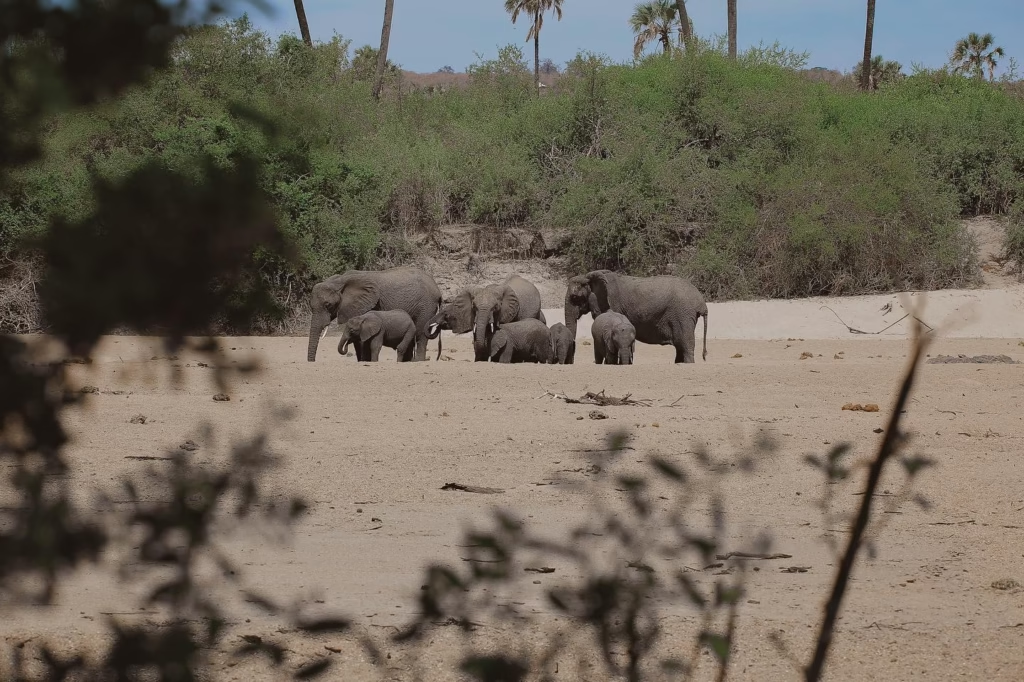
Serengeti elephants move in tight-knit family herds, led by experienced matriarchs. You’ll see them shifting between woodlands and open plains, depending on water and food availability. There’s a quiet intelligence in how they move—deliberate, connected, almost ceremonial. In 2026, populations remain stable, and sightings are frequent, especially near river systems and forested zones.
- 🐃 Buffalo — power in Numbers
Buffalo don’t just gather—they assemble. Herds can swell into the hundreds or even thousands, especially near water sources. There’s a raw, collective power in their presence—muscular, alert, and unpredictable when threatened. Unlike other grazers, buffalo hold their ground. When you see a herd, you feel it. - 🦏 Black Rhino — The Rare Legend
The most elusive of the Big Five. With fewer than 70 individuals in the Serengeti ecosystem, black rhinos are heavily protected and incredibly difficult to spot. Sightings are rare—often under 20% even on well-planned safaris. But that rarity is exactly what makes the encounter unforgettable. This isn’t a guaranteed moment. It’s a privilege.
✨In the Serengeti, the Big Five aren’t just animals—they’re experiences. Some will find you easily. Others will test your patience. But together, they define what it means to witness the wild, unfiltered and alive.✨
1.2 The Great Migration Superstars
If the Big Five are the icons, then the Great Migration is the heartbeat of the Serengeti—the force that shapes everything else. This is movement on a scale that defies logic, where the land itself seems to ripple with life.
- 🐃 Wildebeest — The Pulse of the Plains
At the center of it all are the wildebeest—over 1.5 million strong during the calving season (January–March) in the southern plains. This is where the drama intensifies. Within a matter of weeks, hundreds of thousands of calves are born, turning the landscape into both a nursery and a hunting ground. The sheer density is overwhelming—columns stretching to the horizon, hooves drumming like distant thunder. If you want to feel the Serengeti, this is where it happens. 🦓 Zebras — The Strategic Companions
Zebras don’t just follow—they partner. Moving alongside wildebeest, they play a crucial ecological role. Zebras graze on taller, tougher grasses first, clearing the way for wildebeest to feed more efficiently on shorter growth. It’s a quiet, intelligent collaboration. Visually, they add contrast to the chaos—black and white stripes cutting through golden plains, often acting as the migration’s early navigators.
🌍 Movement Patterns — Timing Is Everything
The migration is not static—it’s a continuous loop driven by rainfall, grass quality, and instinct.
- January–March: Southern plains (calving season, high predator activity)
- April–June: Movement northward as rains fade
- July–October: River crossings in the northern corridors—arguably the most dramatic phase
- November–December: Return south as rains begin again
Here’s the truth: you don’t just visit the Serengeti—you time it. The difference between seeing scattered herds and witnessing a living river of animals comes down to when—and where—you arrive.
✨Catch the migration at the right moment, and you won’t just see Serengeti animals—you’ll witness one of the greatest natural spectacles on Earth, unfolding in real time.✨
1.3 Predators & Hunters
Beneath the beauty of the Serengeti lies a sharper truth: everything is in motion, and everything is being watched. The predators here are not just survivors—they are tacticians, each with a distinct style, rhythm, and role in the ecosystem’s relentless choreography.
- 🐆 Cheetahs — Speed with Precision
On the open southeastern plains, where visibility stretches for miles, cheetahs thrive. Built for speed rather than strength, they are the only major predators that hunt primarily during the day, using sunlight to their advantage while avoiding competition from lions and hyenas. You’ll often spot them scanning from termite mounds, bodies still, eyes calculating. When they move, it’s explosive—a blur of intent and instinct. In 2026, they remain one of the most thrilling daytime sightings in the Serengeti. 🐾 Hyenas — Behind the Myth
Hyenas carry an unfair reputation. Yes, they scavenge—but they are also highly skilled hunters, operating with intelligence, coordination, and endurance. Their clans can take down large prey and defend kills against bigger predators. At night, their calls echo across the plains—wild, eerie, unforgettable. In truth, hyenas are among the most efficient predators in the Serengeti, playing a crucial role in keeping the ecosystem balanced.
⚖️ Predator–Prey Dynamics — The Real Drama
Nowhere is the tension more palpable than during the Great Migration. As wildebeest and zebras move in vast numbers, predators follow closely, turning opportunity into survival.
- Calving season brings vulnerable young—and heightened hunting success
- River crossings create chaos, where hesitation can mean death
- Open plains favor speed hunters like cheetahs, while ambush predators wait for mistakes
This is not random. It’s a system—finely tuned, brutally honest, and endlessly fascinating. Every chase, every escape, every failed attempt adds to the balance that defines the Serengeti.
✨Here, survival isn’t guaranteed—it’s negotiated in real time. And witnessing that exchange? That’s where the Serengeti becomes unforgettable.✨
1.4 Plains & Woodland Regulars
Not every Serengeti moment is about the chase. Some of its richest experiences come from the constants—the animals that quietly anchor the landscape, filling the spaces between drama with rhythm, grace, and presence. These are the species that turn a good safari into a complete one.
- 🦒 Giraffes — The Silent Browsers
Moving with slow elegance through acacia woodlands, giraffes seem almost unreal—too tall, too composed, too calm for the wild chaos around them. They feed high above the reach of others, stripping leaves with precision, often pausing to observe with a quiet curiosity. You don’t just see giraffes—you notice how they frame the landscape, adding height and stillness to an otherwise restless world. - 🦛 Hippos — Power Beneath the Surface
At first glance, a hippo pool looks peaceful—just a cluster of rounded backs and blinking eyes. But beneath that calm lies tension. Hippos are intensely social and territorial, spending their days submerged in rivers and pools, emerging at dusk to graze. Listen closely: grunts, splashes, sudden lunges. It’s a world of hidden dynamics, where space is negotiated constantly. 🦌 The Antelope Ensemble — Movement Everywhere
This is where the Serengeti truly comes alive.- Impala: agile, alert, always on edge
- Topi: muscular and statuesque, often standing elevated to scan for danger
- Thomson’s gazelles: small, fast, and endlessly energetic
They are everywhere—and that’s the point. Their constant movement creates a sense of flow across the plains, feeding predators, shaping grazing patterns, and filling the landscape with life.
✨Why They Matter✨
These species may not headline travel brochures, but they define the texture of your safari. They ensure that no moment feels empty, no drive feels silent. Between rare sightings and dramatic hunts, they provide continuity—life in its most natural, unforced form.
✨Because in the Serengeti, a “full safari experience” isn’t just about what’s rare—it’s about what’s always there, quietly making the wild feel alive.✨
2. Birdlife in the Serengeti: A Hidden Safari Highlight
When people think of Serengeti animals, their minds go straight to lions and elephants. Fair. But lift your gaze—just slightly—and an entirely different safari unfolds. One of wings, silhouettes, and quiet dominance. The Serengeti’s birdlife doesn’t compete with the mammals—it completes them.
2.1 The Giants of the Sky & Land
These are not delicate, fleeting birds. These are the heavyweights—the ones that command space, reshape expectations, and often stop you mid-sentence.
- 🪶 Ostrich — The Undisputed Giant
The largest bird on Earth, the ostrich doesn’t bother with flight—it owns the ground instead. Long legs, powerful stride, and a presence that feels almost prehistoric. Males in breeding plumage (black and white) stand out dramatically against the plains, while females blend into the landscape with muted tones. Watch them run, and you’ll understand: speed replaces wings here. - 🪽 Kori Bustard — The Reluctant Flyer
Often overlooked until it moves, the kori bustard is one of the heaviest flying birds in the world. Most of the time, it walks—slow, deliberate, grounded. But when it finally takes off, it’s a moment of pure effort and surprise. There’s a weight to its flight, a sense that gravity is being negotiated rather than defeated. - 🦤 Ground Hornbills — Echoes of Another Age
With their bold black bodies, striking red facial skin, and deep, resonant calls, ground hornbills feel like they belong to another era. They stride across the savannah in small groups, hunting insects and small animals with methodical precision. There’s something almost ceremonial in how they move—unhurried, deliberate, and unmistakably ancient.
✨These giants remind you that the Serengeti isn’t just about what roars or runs. Sometimes, the most unforgettable encounters come on wings—or on feet that never needed them.✨
2.2 Color, Sound & Movement
If the giants command presence, these birds command attention. They flash, call, and stride their way into your memory—turning quiet drives into moments you didn’t know you were waiting for.
- 🎨 Lilac-breasted Roller — The Living Postcard
This is the bird you’ll see on postcards—and then suddenly, right there on a roadside branch. Electric blues, lilacs, greens, and rust tones layered like a painter got carried away. The lilac-breasted roller doesn’t just sit pretty either; during flight, it performs quick aerial rolls that give it its name. Blink, and you miss it. Catch it—and you’ve got one of the most iconic Serengeti images. - 🦅 African Fish Eagle — The Voice of the Wild
Before you see it, you hear it. That unmistakable, echoing cry—part whistle, part wail—cuts across rivers and lakes, instantly anchoring you in Africa. Perched high near water, the African fish eagle scans with quiet authority before swooping down with precision. It’s not just a sighting—it’s a soundtrack moment, one that stays with you long after the safari ends. - 🦩 Secretary Bird — Precision on Stilts
Tall, striking, and oddly elegant, the secretary bird walks the plains like it has somewhere important to be. Long legs, sharp gaze, and a very specific skill: hunting snakes. When it strikes, it does so with rapid, powerful stomps—controlled, efficient, final. It’s a reminder that in the Serengeti, even the most graceful creatures can be formidable hunters.
✨Here, color flashes, calls echo, and movement tells stories. And just like that, the sky—and the ground—become part of your safari in ways you didn’t expect.✨
2.3 Raptors & Scavengers
Not all drama in the Serengeti is loud. Some of it begins in silence—high above, where circles tighten slowly in the sky. If you know how to read it, that motion tells a story before you even arrive.
- 🦅 Rüppell’s Vultures — The Aerial Signal
Look up during the migration and you may spot them: Rüppell’s vultures, riding thermals in wide, deliberate spirals. They don’t chase—they wait, watching for opportunity below. Their presence often means one thing: a kill has happened… or is about to. In that sense, they become guides of a different kind, leading you to the hidden aftermath of predator-prey encounters. - ⚖️ The Clean-Up Crew — Nature’s Quiet Balancers
It’s easy to overlook scavengers, but the Serengeti would not function without them. Vultures, along with other raptors and opportunistic feeders, perform a critical role—rapidly consuming carcasses, preventing the spread of disease, and recycling nutrients back into the ecosystem. What looks like chaos at a kill site is actually efficiency at work.
There’s no waste here. Every end feeds a beginning.
✨In the Serengeti, even death has purpose—and from above, the sky keeps watch, ensuring the balance never breaks.✨
2.4 Serengeti Endemics & Specials
Beyond the obvious stars lies a quieter layer of discovery—the birds that don’t announce themselves, but reward those who look closer. These are the Serengeti’s specials: species tied closely to this ecosystem, often missed by hurried eyes, but unforgettable once found.
- 🐦 Grey-throated Spurfowl — The Subtle Native
Blending effortlessly into dry grass and scrub, the grey-throated spurfowl is easy to overlook—until it moves. Its patterned plumage is designed for camouflage, and its presence is often revealed by quick bursts of motion or soft calls rather than bold display. A true “you either notice it or you don’t” kind of bird. - 🌿 Schalow’s Turaco — The Woodland Jewel
Step into denser vegetation, and the Serengeti shifts tone. Here, Schalow’s turaco flashes through the canopy—green, grey, and crimson in motion. It’s less about prolonged viewing and more about fleeting beauty: a glide between branches, a rustle, a glimpse of color that feels almost imagined. - 🪺 Rufous-tailed Weaver — The Patient Builder
Small but industrious, the rufous-tailed weaver tells its story through structure. Look for intricately woven nests hanging from branches—carefully constructed homes that reveal the bird’s presence long before you see the bird itself. It’s a reminder that in the Serengeti, detail matters as much as scale.
📍 Where to Find Them — Go North, Slow Down
Your best chances to spot these species come in the northern woodlands and the Lobo area, where thicker vegetation and quieter landscapes create ideal conditions. Fewer crowds, more patience, and a willingness to pause—that’s the formula.
✨These aren’t checklist birds. They’re discoveries. And in finding them, you realize the Serengeti isn’t just vast—it’s layered, waiting to be read by those who take their time.✨
2.5 Best Time for Birdwatching
Timing, in the Serengeti, is everything—and for birdlife, it can transform a good safari into a spectacle of wings, color, and sound.
- 🌦️ November–April — When the Skies Come Alive
This is peak birding season. As rains return, the Serengeti shifts from dusty gold to vibrant green—and with it comes a migratory influx of species from Europe and North Africa. Resident birds enter breeding season, displaying brighter plumage, heightened activity, and more vocal behavior. In short: everything becomes easier to see, hear, and appreciate. It’s not just more birds—it’s birds at their best. 👀 Practical Viewing Tips — Easier Than You Think
Birdwatching here isn’t reserved for experts with heavy gear. In fact, the Serengeti makes it surprisingly accessible:- Many species are large, colorful, and active in open spaces—easy to spot even without binoculars
- Birds often perch close to tracks and roads, especially rollers, hornbills, and bustards
- Early mornings and late afternoons offer the best light—and the most movement
- Let your ears guide you: distinctive calls (like the fish eagle’s) often lead you straight to the source
✨In the Serengeti, birdwatching doesn’t feel like a separate activity—it unfolds naturally around you. All you have to do… is start noticing.✨
3. Rare Sightings: The Ones Everyone Hopes For
Not everything in the Serengeti reveals itself easily. Beyond the herds and familiar silhouettes lies another layer of the wild—quieter, rarer, and far less predictable. These are the sightings people whisper about, the ones that turn an already great safari into a story told for years. But here’s the truth: rarity demands humility. You don’t chase these moments—you earn them, or you don’t.
3.1 Black Rhino: The Ultimate Safari Prize
There is rare… and then there is the black rhino.
With fewer than 70 individuals remaining in the Serengeti ecosystem, this is one of the most protected—and elusive—animals you could hope to encounter. Decades of poaching pushed them to the brink, and while conservation efforts have stabilized their numbers, visibility remains intentionally limited.
These rhinos are typically found within highly protected zones, often monitored closely by rangers and tracked discreetly by experienced guides. Even with that expertise, sightings are never guaranteed. In fact, your chances often sit at below 20%, even on a well-planned safari.
And yet—that’s exactly what makes it matter.
A black rhino sighting isn’t just another tick on a list. It’s a moment charged with weight: history, survival, and resilience all standing before you in living form. There’s no spectacle, no dramatic chase—just a quiet, powerful presence that feels almost unreal in its rarity.
✨In a place defined by abundance, the black rhino reminds you of something deeper: that some of the most meaningful encounters in the Serengeti are the ones you can’t plan for.✨
3.2 African Wild Dogs: The Ghost Packs
They move like rumors—seen by few, remembered by all. African wild dogs are among the Serengeti’s most elusive predators, not because they lack presence, but because their numbers are small and fragile. Highly social and fiercely intelligent, they operate in tight-knit packs with remarkable coordination—but disease and habitat pressure have kept their population vulnerable.
Unlike lions or hyenas, wild dogs don’t dominate territory in obvious ways. They travel—wide, fast, and often unpredictably. One day they’re here, the next they’ve vanished beyond the horizon. Even seasoned guides treat sightings as something close to luck meeting perfect timing.
And the odds? Less than 10% on a standard safari.
But if it happens—if you catch a glimpse of mottled coats flashing through the grass, or witness a pack in motion—you’re seeing one of Africa’s most efficient hunters at work. Their hunts are fast, cooperative, and often successful, built on stamina rather than brute force. There’s a raw, electric energy to them—less regal than lions, more relentless.
✨They’re not part of the usual story. They’re the rare chapter—brief, intense, and unforgettable for those who get to read it.✨
3.3 Pangolins: The Night Wanderers
There are animals you hope to see… and then there are animals you almost don’t expect to exist—until, somehow, they do. The pangolin belongs firmly in the latter.
Shy, solitary, and strictly nocturnal, pangolins move through the Serengeti under the cover of darkness, emerging from burrows to forage for ants and termites. Their armor of overlapping scales gives them an almost mythical appearance—part mammal, part ancient relic. When threatened, they don’t run or fight—they simply curl into a tight, impenetrable ball. Quiet. Untouchable. Gone.
But here’s the reality: sightings are extremely rare and wildly unpredictable. Even guides who have spent years in the Serengeti may only encounter one a handful of times—if at all. There are no reliable locations, no guaranteed strategies, no “best time” beyond being out at night and extraordinarily lucky.
And that’s what defines the experience.
✨A pangolin sighting isn’t planned—it’s stumbled upon. A fleeting intersection between your world and something far more secretive. And if it happens, even for a moment, it becomes the kind of story that doesn’t quite feel real when you tell it later.✨
3.4 Elusive Big Cats
Not all big cat encounters come easy. Some demand time, silence, and a willingness to wait without guarantee. These are the sightings that test your patience—and reward it in ways nothing else can.
- 🐆 Leopards — Masters of Disappearance
Solitary by nature and guided by the shadows, leopards are the Serengeti’s ultimate illusionists. They move quietly, hunt alone, and rest where few think to look—often draped over tree branches, perfectly camouflaged against bark and leaves. Their nocturnal habits make them especially active at dusk and through the night, slipping between visibility and invisibility with ease. A leopard sighting doesn’t feel like discovery—it feels like permission. - 🐆 Cheetah Mothers with Cubs — Fragile Moments in the Open
Cheetahs may be easier to spot than leopards, but witnessing a mother with cubs is something else entirely. These moments are rare not because cheetahs are scarce, but because survival is difficult. Cubs are vulnerable—to predators, to harsh conditions, to chance itself. When you do find them, it often requires patience: long waits, careful observation, and a bit of luck.
And when it happens? The scene slows down. A mother scanning the horizon. Cubs playing, learning, surviving. It’s not just a sighting—it’s a glimpse into the future of the species.
✨These are not guaranteed encounters. They are earned—through time, stillness, and a quiet respect for how the wild chooses to reveal itself.✨
3.5 Honest Safari Expectations
Let’s be clear—Serengeti magic doesn’t come from guarantees. It comes from the unknown.
Yes, the odds are in your favor. On a well-planned safari, you can expect an 80–90% chance of seeing the Big Five—with one exception: the black rhino, which remains a rare bonus rather than a baseline expectation. Lions? Likely. Elephants and buffalo? Very likely. Leopards? Possible, with timing on your side. But never promised.
Because here’s what truly shapes your experience:
- ⏳ Timing: The Serengeti shifts with the seasons. Migration patterns, rainfall, and temperature all influence where animals move—and when they’re visible.
- 🧭 Guide Expertise: A skilled guide doesn’t just drive—they read the land. Tracks, bird calls, distant movement—small clues that lead to big moments.
- 📍 Location: The Serengeti is vast. Being in the right region at the right time can mean the difference between scattered sightings and unforgettable encounters.
And then there’s the final factor—the one no one can control.
The Serengeti is not curated. It doesn’t perform on command. Some days, everything aligns: predators hunt, herds move, and the landscape feels alive with coincidence. Other days, it’s quieter—subtle, slower, almost meditative.
But that unpredictability? That’s not a flaw. It’s the point.
✨Because in the Serengeti, you’re not watching a show—you’re stepping into a living world that owes you nothing… and gives you everything when it chooses to.✨
4. When & Where to See the Best Serengeti Animals in 2026
In the Serengeti, where you go matters just as much as when you go. This isn’t a single landscape—it’s a shifting mosaic, with each region telling a different chapter of the same story. Get the timing right, and the Serengeti doesn’t just show you animals—it reveals entire ecosystems in motion.
- 🌱 Southern Plains (January–March) — The Season of New Life & High Drama
This is where the year begins with intensity. The calving season transforms the southern plains into a vast nursery, as hundreds of thousands of wildebeest give birth within weeks. But where there is vulnerability, predators follow. Lions, cheetahs, and hyenas are highly active, making this one of the best times to witness raw predator-prey interactions. It’s fast, emotional, and unforgettable. - 🌍 Central Serengeti — The Reliable Core
If consistency had a location, this would be it. The central region offers year-round wildlife density, making it ideal for travelers who want strong chances of seeing a wide range of Serengeti animals regardless of season. Resident predators, permanent water sources, and steady prey populations create a balanced, dependable safari experience. - 🌊 Northern Serengeti — The Crossing of Courage (Seasonal)
Timing here is everything. Between roughly July and October, the northern Serengeti becomes the stage for the iconic river crossings. Wildebeest and zebras gather, hesitate, and then surge across crocodile-filled waters in chaotic bursts of movement. It’s tension, instinct, and survival compressed into moments that feel almost cinematic. Miss the timing, and the region feels quiet. Hit it right, and you witness one of nature’s greatest spectacles. - 🌿 Western Corridor — Rivers, Forest Edges & Hidden Predators
Less talked about, but deeply rewarding. The western corridor follows river systems like the Grumeti, where lush vegetation meets open plains. This mix attracts diverse wildlife—and large crocodiles that lie in wait during migration crossings. It’s a region of contrasts: slower-paced, richer in detail, and perfect for those who want something beyond the obvious highlights.
✨In 2026, the Serengeti isn’t about choosing a single “best” place—it’s about aligning your journey with the rhythm of the land. Because here, the right place at the right time doesn’t just improve your safari… it transforms it.✨
5. Conclusion: Your 2026 Serengeti Wildlife Checklist
The truth about Serengeti animals is simple—and powerful: you will see a lot… but what you experience depends entirely on how you plan.
If your goal is the Big Five, focus on regions with year-round density and give yourself time. If you’re chasing the Great Migration, timing becomes everything—arrive too early or too late, and the story shifts. And if it’s the rare, once-in-a-lifetime sightings—the rhino, the wild dogs, the unexpected—then patience isn’t optional, it’s part of the journey.
That’s the dual nature of the Serengeti. On one hand, it’s predictable in its abundance—wildlife is everywhere, movement is constant, and the ecosystem never feels empty. On the other, it’s beautifully unpredictable in its details—the rare moments, the fleeting encounters, the things you can’t schedule but never forget.
So treat this not just as a trip, but as a strategy.
Plan early. Travel with intention. Choose guides who don’t just know the roads—but understand the land.
✨Because in 2026, the Serengeti won’t just show you animals—it will show you moments. And the right preparation is what turns those moments into something extraordinary.✨
FAQs: Serengeti Animals in 2026✨
1. What Serengeti animals are easiest to see on a safari?
The easiest Serengeti animals to spot include lions, elephants, buffalo, giraffes, zebras, and various antelope species like impala and Thomson’s gazelles. These animals are abundant and often visible throughout the year, especially in central regions.
2. What is the best time to see Serengeti animals in 2026?
It depends on your goal. For the Great Migration calving season, visit between January and March. For river crossings, aim for July to October. If you want consistent wildlife viewing, the central Serengeti is excellent year-round.
3. Can you see the Big Five in the Serengeti?
Yes, the Serengeti is home to the Big Five—lion, leopard, elephant, buffalo, and black rhino. However, while four are commonly seen, black rhinos are extremely rare, making a full Big Five sighting less guaranteed.
4. How likely is it to see a black rhino in the Serengeti?
Sightings are rare, with less than a 20% chance even on a well-planned safari. They are heavily protected and found in limited areas, often requiring expert guides and some luck.
5. Are Serengeti animals active all year round?
Yes, wildlife is present year-round, but movement patterns change with seasons. The Great Migration causes large shifts in animal concentrations depending on rainfall and grazing conditions.
6. Do I need binoculars for birdwatching in the Serengeti?
Not necessarily. Many bird species are large, colorful, and visible at close range. However, binoculars can enhance the experience, especially for spotting smaller or distant species.
7. What are the rarest animals in the Serengeti?
Some of the rarest Serengeti animals include black rhinos, African wild dogs, and pangolins. These species are difficult to spot due to low populations, nocturnal habits, or wide-ranging movement.
8. How many days do I need to see the best Serengeti animals?
A minimum of 3–5 days is recommended for a good experience, but 5–7 days significantly improves your chances of seeing a wider variety of Serengeti animals, including rarer sightings.