
Tanzania Safari: When to Go for the Best Experience
Table of Contents
ToggleIntroduction: So, When Should You Go on a Tanzania Safari?
So, When Should You Go on a Tanzania Safari?
Wondering when to go on a Tanzania safari? The short answer is: it depends on what you want to experience.
There is no single best month for every Tanzania safari. For the most reliable combination of dry weather, accessible roads and predictable wildlife viewing, June to October is the classic choice. If your priority is wildebeest calving, predator activity and lush green landscapes, January to March can be especially rewarding. For lower prices and fewer visitors, April and May can offer excellent value, but you should be prepared for heavier rain, muddy roads and a greater possibility of changes to your itinerary.
The best time for your safari therefore starts with a simple question: What do you want from your safari?
Are you hoping to see the Great Migration or witness newborn wildebeest in the southern Serengeti? Perhaps your priority is general wildlife viewing, photography or bird watching. Families may prefer predictable weather and easier road conditions, while budget travellers may be willing to accept rain in exchange for lower rates. If peace and solitude matter most, quieter months or less-visited parks may be more appealing. And if you are combining your safari with a Zanzibar beach holiday, the timing of both destinations becomes important.
Tanzania’s wildlife areas change dramatically throughout the year. Understanding those seasonal differences allows you to choose dates based on your experience—not simply a calendar of “good” and “bad” months.
2. Why Timing Matters for a Tanzania Safari
Choosing when to go on safari is about much more than checking the weather forecast. The month you travel can influence what you see, how easily you move between parks, what you pay and even the atmosphere of your safari.
2.1 Wildlife Visibility
During dry periods, vegetation becomes thinner and animals often gather around permanent rivers, lakes and waterholes. This can make wildlife easier to spot, particularly in open areas.
2.2 Water and Vegetation
Rain transforms Tanzania’s landscapes. Wet months bring fresh grass, flowers and lush scenery, while dry months create more open views and concentrate wildlife around remaining water sources.
2.3 Road Conditions
Many safari routes use unpaved roads. Heavy rainfall can make some roads muddy, slow transfers and occasionally affect access to remote areas. This is particularly important during the long rains.

2.4 Migration Movements
The Great Migration follows rainfall and fresh grazing rather than a fixed calendar. Your travel dates therefore need to match the region where the herds are likely to be, especially if migration is your main goal.
2.5 Prices and Crowds
Peak dry-season months, particularly July to September, generally bring stronger demand, higher prices and more vehicles at popular wildlife sightings. Quieter periods can offer better value and a more peaceful experience.
2.6 Photography Conditions
Dry months can provide clear skies, open vegetation and excellent visibility. Wet months offer dramatic clouds, vibrant landscapes, reflections and newborn animals—often creating a completely different photographic experience.
2.7 Camp Availability
Seasonal camps may open or close depending on rainfall, demand and accessibility. Always confirm that your preferred accommodation will be operating during your travel dates.
Key takeaway: The same month can be excellent for one traveller and inconvenient for another. The right timing depends on your priority—wildlife, migration, photography, budget, family comfort, fewer crowds or a safari-and-beach combination.
Ready to Plan Your Tanzania Safari?
Don’t choose your dates based on a generic calendar alone. Tell us when you’re considering travelling and what you most want to experience, and we can help match your dates with the right parks, route and safari style
🦓 PLAN YOUR TANZANIA SAFARI
 Tell us your travel dates, budget, and preferences
 We craft your personalized Tanzania Safari itinerary
 Confirm your booking & get ready for the adventure of a lifetime
3. Tanzania's Climate: Understanding the Safari Seasons
Before choosing the best time for a Tanzania safari, it helps to understand one important fact: Tanzania does not have one uniform climate. The country is vast, and altitude, geography and proximity to the coast can create very different conditions from one destination to another.
3.1 Tanzania Doesn't Have One Uniform Climate
The Serengeti generally experiences a dry period from June to October, with rainfall influencing the movement of the Great Migration. The Ngorongoro Highlands are cooler because of their elevation and can be noticeably colder, particularly in the early morning.
Tarangire has a strong seasonal pattern, and wildlife often becomes increasingly concentrated around the Tarangire River during the dry months. Lake Manyara can remain productive throughout much of the year, while its vegetation and birdlife change significantly with rainfall and water levels.
Further south, Ruaha and Nyerere National Park experience their own seasonal rhythms. The dry season can produce excellent wildlife viewing as animals gather around remaining water sources, while wet-season access can be more challenging in some areas.
Then there is Zanzibar, where the tropical coastal climate is warmer and more humid than the mainland safari areas. Its rainfall patterns also differ from those of the Serengeti and northern Tanzania.
This regional variation means that the best time to visit one destination may not necessarily be the best time for another.

3.2 Tanzania's Major Safari Seasons
Period | Typical conditions | Safari experience |
June–October | Dry, generally clear | Excellent general wildlife viewing, easier road conditions and strong visibility |
November–December | Short rains | Green landscapes, fewer visitors and refreshing seasonal showers |
January–February | Relatively dry in many northern areas | Excellent period for calving, predators and green scenery |
March–May | Long rains | Lush scenery, lower prices and fewer visitors, but greater access risk |
These are broad seasonal patterns rather than guarantees. Rainfall can arrive earlier, later or with different intensity from one year to another.
3.3 Vuli vs. Masika: Tanzania's Two Rainy Seasons
Tanzania’s rainfall is commonly described using two Swahili terms.
Vuli refers to the short rains, generally occurring around November and December, although the timing varies by region and year.
Masika refers to the long rains, typically occurring from around March through May. April and May are usually the wettest months in many safari areas.
Importantly, rain does not automatically mean a poor safari. Short showers can transform the landscape into lush green country and create excellent photographic conditions. The bigger concern during the long rains is the potential effect of persistent rainfall on roads, transfers, camps and access to remote areas.
Planning tip: Don’t choose your safari dates based on a national weather calendar alone. Match the season to the specific parks you plan to visit and the experience you want.
Ready to choose your dates? Contact Grey Joy Safari Adventures for help matching your travel dates with the right Tanzania safari route, parks and accommodation.
4. Dry Season: June to October
For many travellers, June to October is the classic Tanzania safari season. Rainfall is generally lower, vegetation becomes thinner and wildlife is often easier to spot across open landscapes. Roads are also typically more accessible, making this period particularly attractive for first-time visitors who want predictable safari conditions.
4.1 Why June to October Is Tanzania's Classic Safari Season
As the dry season progresses, grasses and vegetation become less dense, improving visibility across the plains. Water also becomes increasingly important. Animals often gather around permanent rivers, lakes and waterholes, creating excellent opportunities for wildlife viewing.
The combination of reduced vegetation, concentrated wildlife, generally easier roads and more predictable weather makes June to October a dependable window for exploring destinations such as the Serengeti, Ngorongoro, Tarangire and the Southern Circuit.
4.2 Advantages of the Dry Season
- Strong wildlife viewing: Animals are easier to locate in many areas.
- Good road conditions: Lower rainfall generally means fewer muddy or flooded routes.
- Lower humidity: Conditions can feel more comfortable, particularly during game drives.
- Comfortable safari conditions: Clearer skies and cooler mornings are common.
- Excellent photography: Better visibility, open landscapes and dramatic wildlife encounters create strong photographic opportunities.
- Reliable logistics: Transfers and game drives are generally less affected by weather.
4.3 Disadvantages of the Dry Season
The classic safari season also comes with trade-offs.
- Higher prices: Demand for camps, lodges and safari vehicles increases.
- More visitors: Popular parks and famous wildlife sightings can become busy.
- Crowded sightings: Multiple vehicles may gather around particularly sought-after animals.
- Drier landscapes: Some areas become dusty and brown compared with the vibrant green season.
4.4 June vs. July vs. August vs. September vs. October
June: A strong shoulder-season option. The landscape may still retain some greenery as the rains end, while visitor numbers can be lower.
July: Dry conditions become more established, with strong general wildlife viewing and increasing migration activity in parts of the Serengeti.
August: One of the busiest months, offering dependable dry-season conditions and opportunities for northern Serengeti migration sightings.
September: Continues to offer dry weather and excellent wildlife viewing, while crowds may ease slightly depending on the destination.
October: A strong late-dry-season month. Wildlife can remain concentrated around water, although temperatures rise and early short rains may appear toward the end of the month.
Planning tip: If you want the reliability of the dry season but prefer to avoid its busiest period, consider June or October and discuss your specific route with an experienced safari operator.
🦓 PLAN YOUR TANZANIA SAFARI
Tell us your travel dates, budget, and preferences We craft your personalized Tanzania Safari itinerary Confirm your booking & get ready for the adventure of a lifetime
5. Wet Season: November to May
Wet season does not mean bad safari. In fact, some of Tanzania’s most spectacular landscapes and wildlife experiences occur during the greener months. Rain brings fresh grass, flowers, migratory birds and newborn animals, while visitor numbers and prices can be lower in certain periods.
The important consideration is not simply whether it rains, but how rainfall affects wildlife, roads, accommodation and your overall itinerary.
5.1 November–December: The Short Rains
The short rains begin to transform Tanzania’s landscapes, bringing fresh green vegetation and reducing the dust that can dominate the later dry season.
This period can offer:
- Green landscapes that are excellent for photography.
- Fewer visitors than the peak July–September period in many areas.
- Arrival of migratory birds from Europe and northern Africa.
- Showers that are often brief and manageable, although timing varies.
- Potentially better value on selected accommodation and safari packages.
November and December can therefore be an attractive option for travellers who want greener scenery without accepting the greater access risks associated with the long rains.
5.2 January–February: The Green Season and Calving
January and February are particularly important for travellers interested in the southern Serengeti and Ndutu. Fresh grass following the rains supports large concentrations of wildebeest and other herbivores, while the calving season creates opportunities to witness newborn animals and increased predator activity.
Expect:
- Wildebeest calving in the southern Serengeti and Ndutu area.
- Increased opportunities for predator sightings.
- Vibrant green scenery.
- Excellent conditions for wildlife and landscape photography.
- Generally good safari opportunities between seasonal showers.
For photographers and travellers more interested in animal behaviour than dry-season conditions, this can be an exceptionally rewarding period.
5.3 March–May: The Long Rains
The long rains generally bring the greatest weather and access challenges. Rainfall increases, roads can become muddy and some seasonal camps may close or operate differently.
However, the potential benefits include:
- Lower prices
- Fewer tourists
- Lush, dramatic landscapes
- A quieter safari atmosphere
The trade-off is greater logistical uncertainty, particularly in remote areas.
The important distinction: Rain itself isn’t necessarily the problem—the cumulative impact of rain on roads, transfers and access is. A shower during a game drive can be part of the adventure; prolonged rainfall affecting a remote road or transfer is a different matter.
6. Best Time to Visit Tanzania for Wildlife Viewing
If your main goal is to see as much wildlife as possible, June to October is generally the most dependable time for a Tanzania safari. The dry conditions reduce vegetation, improve visibility and encourage animals to gather around permanent water sources. Roads are also generally easier to navigate, making game drives more predictable.
- Best Overall: June to October
The dry season offers a strong combination of wildlife visibility, accessible roads and relatively predictable weather. It is particularly suitable for first-time safari travellers who want reliable conditions across destinations such as the Serengeti, Ngorongoro and Tarangire.
- Best for Calving and Predators: January to March
For a very different wildlife experience, consider January to March, particularly in Ndutu and the southern Serengeti.
Large numbers of wildebeest gather around fresh grazing areas during the calving season, creating opportunities to see newborn wildebeest and natural predator behaviour. Lions, cheetahs and hyenas are among the predators that take advantage of the abundance of vulnerable young animals.
The combination of green scenery, young wildlife and active predators also makes this period particularly attractive for photography.
- Best for Dry, Predictable Conditions: July to September
If your priority is dependable dry-season weather, July to September is a strong window. Roads are generally easier, vegetation is thinner and wildlife viewing can be highly productive.
The trade-off is straightforward: better predictability + higher demand + higher prices. Popular parks and wildlife sightings can also be busier.
- Best for Fewer Crowds: January, February, June and October
Travellers seeking a quieter experience can consider January, February, June or October. These months can offer a useful balance between wildlife quality and visitor numbers.
However, crowd levels vary considerably by park, camp, specific dates and international holiday periods. A quieter month in one part of Tanzania may still be busy in another.

7. When Is the Best Time for the Great Wildebeest Migration?
The Great Wildebeest Migration is one of Tanzania’s defining wildlife experiences—but it is important to understand that there is no single migration month. The herds move through the Serengeti ecosystem throughout the year, responding primarily to rainfall, fresh grass and water availability. TANAPA describes the Serengeti as a year-round destination, while its current visitor guidance highlights January–February for calving and June–October for migration viewing.
7.1 The Migration Is a Year-Round Cycle
Rather than following a fixed timetable, wildebeest gradually move across the Serengeti-Mara ecosystem. The exact location can change from year to year depending on rainfall and grazing conditions.
7.2 Migration Calendar
Period | Migration phase | Where to consider |
Dec–Mar | Calving | Southern Serengeti / Ndutu |
Apr–May | Northward movement | Central / Western Serengeti |
Jun–Jul | Western movement | Western / Central Serengeti |
Jul–Oct | Northern movement | Northern Serengeti |
Oct–Nov | Southward movement | Northern / Central Serengeti |
Nov–Dec | Return south | Eastern / Southern Serengeti |
The January–March calving season is particularly associated with the southern Serengeti and Ndutu, where fresh grass supports large concentrations of wildebeest and newborn calves.
7.3 Best Time for River Crossings
For travellers hoping to witness a river crossing, July to October is the commonly considered window, particularly in the Northern Serengeti around the Mara River. The western corridor and Grumeti River can also feature migration activity earlier in the season.
August and September are especially popular because they often coincide with northern migration activity, but timing remains dependent on rainfall and herd movements.
7.4 The Truth About River Crossings
A river crossing cannot be guaranteed.
Rainfall influences when and where herds move. They may gather at a river for hours or days, approach the water and turn back, or cross at a different location or time than expected. Wildlife does not follow a safari itinerary.
TANAPA’s Mara River guidelines also emphasise controlled viewing at designated crossing areas, reflecting how unpredictable and sensitive these events are.
7.5 How to Improve Your Chances
If the migration is your priority:
- Spend several nights in the relevant region.
- Choose accommodation based on geographic positioning, not just price.
- Keep the itinerary flexible.
- Travel with an experienced safari guide who can respond to local conditions.
- Avoid planning a migration safari around one night and one hoped-for crossing.
The best migration safari is built around flexibility—not a promise on a calendar.
🦓 PLAN YOUR TANZANIA SAFARI
Tell us your travel dates, budget, and preferences We craft your personalized Tanzania Safari itinerary Confirm your booking & get ready for the adventure of a lifetime
8. Best Time for Bird Watching in Tanzania
If birds are a major reason for your trip, November to April is generally an excellent period to explore Tanzania. This is when many European migratory birds arrive, adding seasonal species to Tanzania’s already impressive resident birdlife.
The wetter months also bring fresh vegetation, water and insect activity, creating favourable conditions for birds. Many species display breeding plumage, making this period particularly rewarding for bird photographers and dedicated birders.
That does not mean bird watching is limited to the wet season. Resident birds can be seen throughout the year, and Tanzania’s diverse habitats support hundreds of species across its national parks and conservation areas.
Best Birding Locations in Tanzania
- Lake Manyara – Its wetlands, forests and open areas attract a wide variety of waterbirds, raptors and woodland species.
- Serengeti – The vast grasslands support both resident species and seasonal migrants, offering excellent opportunities alongside big-game viewing.
- Ngorongoro Conservation Area – The combination of highland forests, crater habitats and open grassland creates varied birding environments.
- Tarangire National Park – Particularly rewarding for birders interested in dry-country species, with baobabs, seasonal wetlands and diverse habitats.
- Nyerere National Park – Rivers, lakes, woodland and floodplains create habitats for a wide range of waterbirds and other species.
Birding or Big Game: Which Season?
Dedicated birding trip → November–April can be excellent, particularly for migratory species, breeding activity and lush scenery.
Big-game safari → June–October is generally easier, with drier roads, thinner vegetation and better conditions for locating large mammals.
If birds are your priority, tell your safari operator before booking so the itinerary can be designed around habitats, timing and the species you hope to see.
9. Best Time for a Family Safari
For many families, June to October is the most practical time for a Tanzania safari. The weather is generally more predictable, roads are usually easier to navigate and thinner vegetation can make wildlife easier for children to spot.
The period also overlaps with school holidays in many international markets, making it convenient for families planning around school schedules. The trade-off is higher demand, particularly in July and August, which can mean higher prices and busier parks.
January–February: A Green-Season Alternative
Families who prefer a greener landscape and a strong wildlife story can also consider January and February. The southern Serengeti and Ndutu may offer opportunities to see wildebeest calving, while predators such as lions, cheetahs and hyenas are active around areas with abundant young animals.
This period can also offer potentially fewer visitors than the peak July–August season, although crowd levels vary by destination and dates.
What Matters More Than the Month?
For a family safari, the itinerary itself can be more important than choosing the “perfect” month. Consider:
- Children’s ages: Younger children may need shorter drives and more frequent breaks.
- Private vs. shared vehicle: A private vehicle provides greater flexibility with departure times and stops.
- Driving distances: Fewer long transfers can make the experience more enjoyable.
- Number of destinations: Visiting fewer parks often creates a more relaxed pace.
- Accommodation policies: Check age restrictions, family rooms and child-friendly facilities.
- Breaks during drives: Plan time for meals, rest and bathroom stops.
Family safari insight: The best family experience often comes from smart itinerary design rather than chasing the perfect wildlife month.
Tell us your children’s ages, travel dates and safari priorities, and we can help design a family-friendly Tanzania itinerary around your needs.
10. Best Time for Budget Travelers
If keeping costs down is a priority, April and May are often the most attractive months for Tanzania safari deals. However, the lower prices come with a clear trade-off: these months fall within the long-rain season, so weather and road conditions are less predictable.
April–May: Lower Prices, Higher Weather Risk
Prices can be lower because of:
- Lower demand during the long rains.
- Fewer visitors in many safari areas.
- Seasonal accommodation patterns, with some camps reducing rates or closing temporarily.
In return, travellers should be prepared for:
- Rain and muddy roads.
- Potential access difficulties.
- Possible seasonal camp closures.
- Longer transfers if road conditions deteriorate.
For flexible travellers, the reward can be quieter parks, lush landscapes and a more intimate safari atmosphere.
November: A Value Alternative
November’s short rains can offer a useful middle ground. The landscape becomes greener, visitor numbers may be lower and showers are often manageable. Conditions vary from year to year, but November can provide better value without the same level of access risk associated with the peak long-rain months.
January–February: Wildlife + Value
January and February can also appeal to budget-conscious travellers who prioritise calving and predator activity over river crossings. The southern Serengeti and Ndutu can offer exceptional wildlife experiences while avoiding some of the peak-season demand of July and August.
💡 Budget warning: Don’t judge a safari deal by price alone.
Before booking, ask whether the quoted price includes park fees, accommodation, meals, transfers, a private vehicle, flights and access to seasonal camps. A low headline price may exclude important costs or reflect seasonal limitations.
The cheapest safari isn’t necessarily the best-value safari—compare what you actually receive for the price.
🦓 PLAN YOUR TANZANIA SAFARI
Tell us your travel dates, budget, and preferences We craft your personalized Tanzania Safari itinerary Confirm your booking & get ready for the adventure of a lifetime
11. When Should You Avoid a Tanzania Safari?
Rather than asking which months you should never visit Tanzania, it is more useful to understand when conditions require greater planning and flexibility.
April and May: Highest Weather and Access Risk
April and May are typically the core long-rain months across many safari areas. Heavy or prolonged rainfall can affect the practical side of a safari more than the wildlife itself.
Travellers may encounter:
- Muddy roads that slow game drives and transfers.
- Difficult road conditions, particularly in remote areas.
- Seasonal camp closures or reduced operations.
- Greater possibility of changes to planned routes.
- Reduced operational flexibility if weather affects access.
The rewards can include lush scenery, fewer visitors and lower prices, so these months can still suit experienced or flexible travellers.
Other Periods That Require Planning
- Late March: Rainfall may be increasing as the long-rain season approaches.
- Early November: The short rains can arrive unpredictably, although conditions may remain very manageable.
- Christmas and New Year: Wildlife conditions can be good, but holiday demand may increase accommodation prices and availability pressure.
- July and August: Weather is generally favourable, but these are among the busiest months. Popular wildlife sightings and camps can become crowded, particularly in high-demand areas.
Key message: There are difficult safari conditions, not necessarily bad safari months. The right choice depends on your priorities, flexibility and tolerance for weather-related uncertainty.
If you are considering travelling during a challenging season, work with an experienced local operator who can adapt the route and accommodation when conditions change.
12. Northern Circuit vs Southern Circuit: When Should You Go?
Tanzania’s safari circuits offer different experiences, and the best travel period can depend on which region you choose.
Northern Circuit
The Northern Circuit includes the Serengeti, Ngorongoro Conservation Area, Tarangire and Lake Manyara. It has Tanzania’s most established safari infrastructure and is particularly popular with first-time visitors.
Goal | Recommended period |
General wildlife | June–October |
Calving | January–March |
Northern migration | July–October |
Green landscapes | November–April |
Budget | April–May |
The Northern Circuit can provide excellent wildlife viewing throughout much of the year, but the experience changes significantly with rainfall, vegetation and migration movements.
Southern Circuit
The Southern Circuit includes Nyerere National Park, Ruaha National Park and Mikumi National Park. For general wildlife viewing, June to October is generally a strong period because dry conditions concentrate animals around rivers and remaining water sources while vegetation becomes less dense.
The major appeal of the Southern Circuit is its sense of wilderness and fewer visitors compared with the busiest Northern Circuit destinations. It can be particularly attractive to travellers who value quieter game drives and a more remote atmosphere.
The trade-off is practical: there are generally fewer transport options, longer distances and greater seasonal variation in access. Some roads and camps can become more difficult to reach during wetter periods.
Planning tip: Choose your circuit based on the experience you want first, then match your travel dates to its seasonal conditions.

13. When Is the Best Time to Visit Zanzibar After a Safari?
Adding Zanzibar to a Tanzania safari creates a classic bush-and-beach holiday, but the ideal timing depends on the conditions you want on the island as well as on the mainland.
June–October: Dry, Cooler and Reliable
June to October is generally one of the most favourable periods for Zanzibar. Expect relatively drier, cooler conditions, making it excellent for beaches, sightseeing, water activities and relaxing after a safari.
It also combines naturally with the mainland’s dry safari season, making this a convenient period for a safari-and-beach itinerary.
January–February: Hotter but Generally Favorable
January and February are typically hotter and more humid, but can offer good beach conditions. These months are particularly attractive if you want to combine a southern Serengeti calving safari with time on Zanzibar.
March–May: Increasing Rainfall
Rainfall generally increases from March, with April and May forming the main rainy period. Beach conditions become less predictable, and heavy rain can affect outdoor activities and sea conditions.
November–December: Short Rains
The short-rain period can bring occasional showers, but also green landscapes and potentially better-value accommodation. Conditions can vary considerably from year to year.
Which Combination Fits You?
- Safari + Zanzibar in the dry season: June–October
- Calving safari + Zanzibar: January–February
- Budget safari + Zanzibar: November or selected low-season dates
Planning tip: If your trip includes both safari and Zanzibar, choose dates that work for the entire journey, rather than optimising only one destination.
🦓 PLAN YOUR TANZANIA SAFARI
Tell us your travel dates, budget, and preferences We craft your personalized Tanzania Safari itinerary Confirm your booking & get ready for the adventure of a lifetime
14. Tanzania Festivals and Cultural Events
If your travel dates are flexible, Tanzania’s cultural calendar can add another dimension to a safari or Zanzibar holiday.
- Sauti za Busara: A major music and performing-arts festival held in Zanzibar, celebrating African and Swahili cultural expression.
- Mwaka Kogwa: A traditional Shirazi New Year celebration particularly associated with Makunduchi in southern Zanzibar.
- Eid: Islamic celebrations are widely observed across Zanzibar and mainland Tanzania, with dates changing according to the Islamic lunar calendar.
- Other cultural and religious celebrations: Local communities hold festivals, ceremonies and events throughout the year.
Planning note: Festival dates and programmes can change. Always verify current dates with official organisers or reliable local tourism sources before booking your trip around a specific event.
Travel Respectfully
Cultural tourism should be approached with the same care as wildlife tourism. Ask before photographing people, dress appropriately for religious or community settings, follow local guidance and avoid treating private ceremonies as tourist performances. When visiting villages or attending cultural events, choose experiences that involve and benefit local communities.
The goal is not simply to witness Tanzania’s culture, but to experience it respectfully.
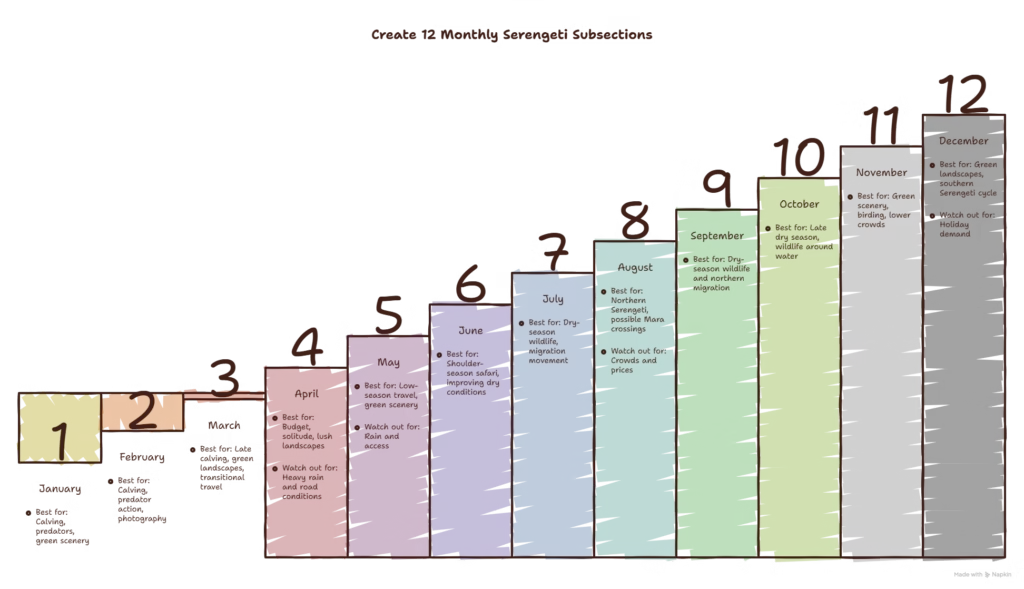
15. Tanzania Safari Month-by-Month Calendar
How to Use This Guide
These periods are matching recommendations, not rankings. A traveller focused on newborn wildebeest may prefer January or February, while someone seeking dry roads and predictable conditions may choose July or September. A budget traveller might accept the greater weather uncertainty of April or May in exchange for lower rates and fewer visitors.
Likewise, migration timing should always be treated as seasonal guidance rather than a guarantee. Rainfall can change where the herds are, while crowd levels can vary between parks and individual dates.
The best time for your Tanzania safari is the period that best matches your priorities, budget, flexibility and preferred destinations.
If you’re unsure which dates fit your plans, contact Grey Joy Safari Adventures with your preferred travel month and safari priorities—we can help match your dates with the right route and experience.
🦓 PLAN YOUR TANZANIA SAFARI
Tell us your travel dates, budget, and preferences We craft your personalized Tanzania Safari itinerary Confirm your booking & get ready for the adventure of a lifetime
16. How to Choose Your Tanzania Safari Dates
Choosing your safari dates becomes much easier when you work backwards from the experience you want. Instead of asking only “When is the best time to visit Tanzania?”, ask “What do I want my safari to be like?”
Step 1: Choose Your Priority
Start with your main objective:
- Wildlife: June–October offers generally reliable game viewing.
- Great Migration: Match your dates to the herds’ seasonal movement.
- Calving and predators: Consider January–March.
- Budget: Look at lower-demand periods such as April–May.
- Birds: November–April can be particularly rewarding.
- Photography: Choose between dry-season visibility and wet-season landscapes.
- Beaches: Consider how your safari dates align with Zanzibar conditions.
Step 2: Choose Your Region
Decide whether your itinerary should focus on the Northern Circuit—Serengeti, Ngorongoro, Tarangire and Lake Manyara—or the Southern Circuit, including Nyerere, Ruaha and Mikumi.
Your chosen region can influence the ideal season, driving distances and available accommodation.
Step 3: Choose Your Tolerance
Be honest about how comfortable you are with:
- Rain and muddy roads
- Crowded wildlife sightings
- Higher prices
- Long driving distances
- Changing weather
- Uncertainty around wildlife movements
Step 4: Build Flexibility Into the Itinerary
This is especially important for Great Migration safaris. Allow several nights in the relevant region rather than relying on a single date for a specific wildlife event.
Step 5: Confirm Operational Details
Before paying a deposit, ask your safari operator:
- Which camps are operating?
- Which roads are accessible?
- Is the vehicle private?
- How many nights are planned in each park?
- What’s included in the quoted price?
- What happens if weather changes the route?
- What is the cancellation or date-change policy?
Good safari planning isn’t about finding a perfect date. It’s about matching your dates, destination and expectations to the experience you actually want.
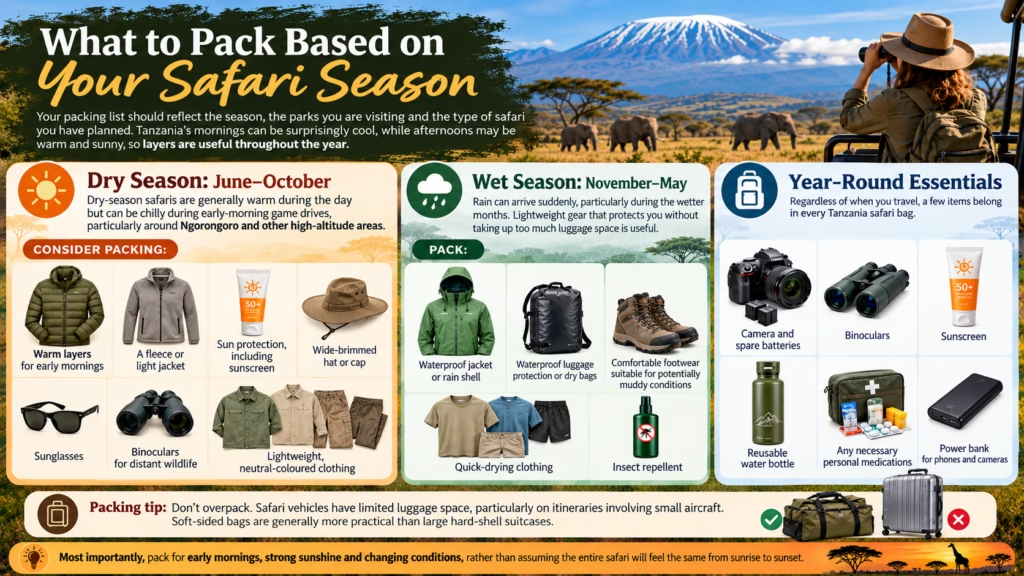
17. What to Pack Based on Your Safari Season
18. Final Verdict: Tanzania Safari When to Go?
So, when should you go on a Tanzania safari? The answer depends on what you want to experience, how flexible you are and which regions you plan to visit.
- For the easiest first safari: June–October offers generally dry weather, accessible roads and reliable wildlife viewing.
- For calving and predator action: January–March, particularly around the southern Serengeti and Ndutu.
- For migration river crossings: July–October, especially in the Northern Serengeti—but no river crossing can be guaranteed.
- For birding and green landscapes: November–April, when migratory birds and lush scenery add another dimension to the safari.
- For the lowest prices: April–May, accepting greater weather and road-access risks.
- For safari + Zanzibar: June–October or January–February, depending on whether you prefer the dry season or want to combine Zanzibar with the calving period.
Ultimately, there is no universally perfect Tanzania safari month.
The best time for a Tanzania safari isn’t simply the month with the best weather. It’s the month that matches what you most want to experience.
Whether you’re chasing the Great Migration, photographing newborn wildebeest, looking for a quieter safari or planning a beach escape in Zanzibar, the right dates can make your journey more rewarding.
19. Frequently Asked Questions
1. What is the best time to go on a Tanzania safari?
June to October is generally the most reliable period for a Tanzania safari, with drier weather, easier road conditions and good wildlife visibility. However, January to March can be better for calving and predator activity, while April and May may suit flexible budget travellers.
2. What is the best month for a Tanzania safari?
There is no single best month for everyone. July to September is excellent for dry conditions and general wildlife viewing, while January and February are particularly appealing for calving, green landscapes and predator activity.
3. When is the Great Wildebeest Migration in Tanzania?
The migration occurs throughout the year. January to March is associated with calving in the southern Serengeti and Ndutu, while July to October is commonly associated with the northern migration and potential Mara River crossings.
4. When is the best time to see the wildebeest river crossings?
July to October is the commonly recommended period for potential river crossings in the Northern Serengeti. However, crossings depend on rainfall and herd movements, so they cannot be guaranteed on specific dates.
5. Is April or May a good time for a Tanzania safari?
April and May can be rewarding for travellers seeking lower prices, fewer visitors and lush green scenery, but they are also the core long-rain months. Muddy roads, difficult access and seasonal camp closures are possible.
6. What is the best time for a family safari in Tanzania?
June to October is often practical for families because weather and road conditions are generally more predictable. January and February can also work well for families interested in calving, predators and green landscapes.
7. When is the best time to combine a Tanzania safari with Zanzibar?
June to October offers a convenient combination of dry safari conditions and generally favourable beach weather. January and February are another attractive option, particularly if you want to combine Zanzibar with the southern Serengeti calving season.
8. What is the cheapest time to go on a Tanzania safari?
April and May often offer some of the lowest safari prices because visitor demand decreases during the long rains. November can also provide better value. Always check what is included in the price, as seasonal accommodation and access can vary.
🦓 PLAN YOUR TANZANIA SAFARI
Tell us your travel dates, budget, and preferences We craft your personalized Tanzania Safari itinerary Confirm your booking & get ready for the adventure of a lifetime